
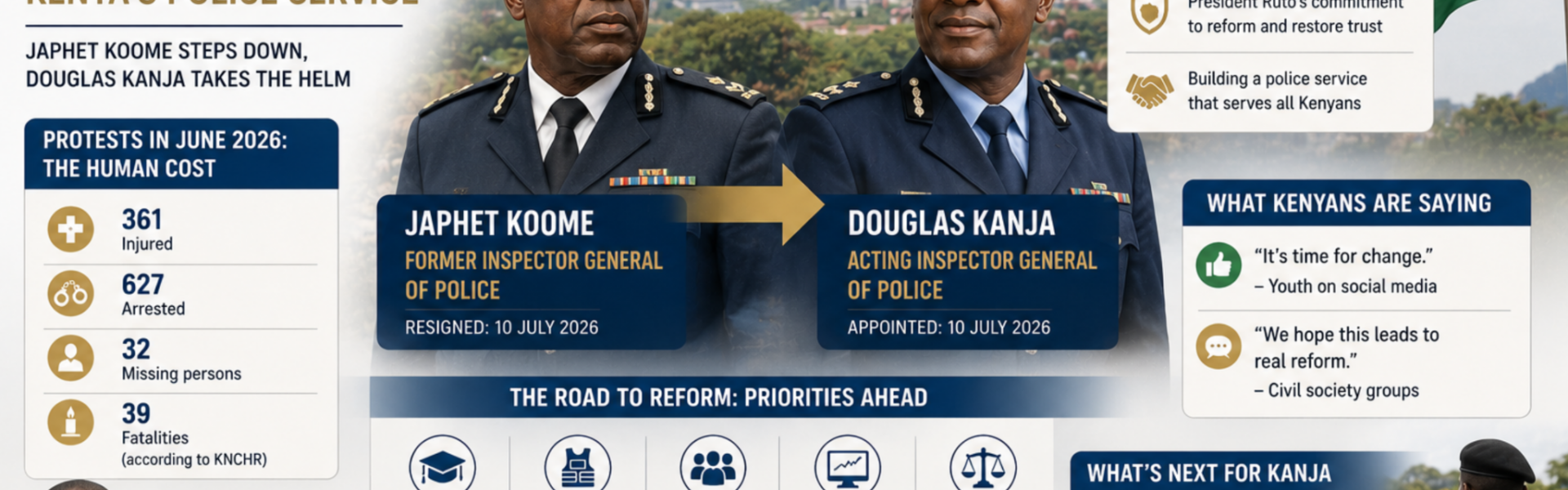
Friday, 10 July. Nairobi woke up to news that was being discussed on every matatu, in every office, and in every kitchen.
Japhet Koome had resigned as Kenya’s Inspector General of Police. For many, this came as a surprise. For analysts, it was a logical step after the events of recent weeks.
While Kenyans discussed the personnel changes on social media, at bus stops, and even on platforms like football betting online, behind the scenes in the corridors of power, a new phase of reforms in the security forces was already being prepared.
How the Situation Unfolded
The beginning of 2026 was challenging for Kenya.
Mass protests took place across the country. The main reason – a new tax bill that the government had tabled. People took to the streets to voice their position.
The police, as expected in such situations, maintained order. But the public felt that law enforcement had been excessively harsh. Videos circulated on social media, sparking widespread outrage.
President William Ruto responded swiftly. He announced the dissolution of the cabinet – 11 officials lost their posts. Then came the police chief’s turn.
Who Is Japhet Koome
Koome became police chief in November 2022. Before that, he was Nairobi police commander. Behind him – decades of service.
He was always regarded as a professional. But his leadership style was controversial. Some called him tough, others called him resolute. In law enforcement circles, he was respected for his principles.
However, in recent months, pressure on him intensified. Human rights organisations demanded investigations. Opposition politicians called for his resignation. And eventually, that pressure became unbearable.
Numbers and Facts
The Kenya National Commission on Human Rights (KNCHR) published a report on the events of June.
| Indicator | Number |
| Injured during protests | 361 |
| Arrested | 627 |
| Missing persons | 32 |
| Fatalities (according to the commission) | 39 |
These figures became the main argument for those demanding Koome’s resignation. The public wanted answers. And the government decided to provide them through personnel changes.
What the President Said
Ruto accepted Koome’s resignation without unnecessary comment.
In an official statement, the president thanked Koome for his years of service and contribution to national security.
“We appreciate the work Japhet has done over his years of service. Kenya remains safe thanks to professionals like him,” the statement read.
Behind the scenes, however, the discussion was different. The resignation was part of a broader restructuring of the security forces that Ruto had announced earlier in the year.
Why This Matters for the Country
The resignation of the police chief is no ordinary event. It affects all areas of life.
Here’s why this decision matters:
- A signal to society. The government is demonstrating that it hears the people’s voice. Even such high offices are not untouchable.
- Police reform. A change of leadership is an opportunity to rethink working methods. A new chief can introduce modern approaches and increase public trust in the police.
- Stability. In times of political turbulence, such decisions help maintain balance and prevent further escalation.
- Transparency. Koome’s resignation shows that the authorities are willing to take responsibility for the actions of the security forces. This is an important step towards openness.
Who Replaced Him
Douglas Kanja was appointed acting Inspector General of Police.
Kanja was Koome’s deputy and a police veteran. He is known as a professional with a solid reputation. In law enforcement circles, he is described as “a man who knows how to connect with people.”
His main task is to restore dialogue between the police and society.
“We need a police force that people trust,” Kanja said in his first interview after his appointment. “We will work on that every day.”
What Lies Ahead for Kenya’s Police
Law enforcement reform is one of the government’s priorities.
Here are the key areas under discussion:
- Professional development. Police officers will undergo regular training in modern working methods.
- Improved working conditions. New equipment, uniforms, and transport – so that officers can work effectively.
- Community engagement. Plans are underway to establish police‑community cooperation councils.
- Transparency. The introduction of digital monitoring systems to track police actions in real time.
These measures are already being discussed in parliament. And the change of leadership should accelerate their implementation.
Public Reaction
Koome’s resignation was met with mixed reactions.
Part of society saw it as a victory. The youth who had taken to the streets saw it as a result of their activism. “We’ve achieved change,” they wrote on social media.
Others were sceptical. “Koome is gone, but the system remains,” they said.
Experts urged against jumping to conclusions. “A change of leadership is an important step, but it’s only the beginning,” says political analyst George Wajackoyah. “Real change will take time and systematic effort.”
What’s Next
Kanja has taken office. Serious work awaits him.
The new police chief’s first steps:
- Meetings with human rights organisations
- Review of police actions during the protests
- Development of a reform plan
- Restoring trust in the police
Experts believe Kanja has a chance to turn things around. “He knows the system from the inside,” says one Interior Ministry official. “And he understands what needs to change.”
Conclusion
Japhet Koome’s resignation was a significant event in Kenya’s political life. It is not just a personnel change – it is a signal of the beginning of a new phase in the development of the law enforcement system.
Ahead lie reforms, changes, and challenges. Whether the new team can handle them – time will tell. But the first step has already been taken.
Kenya is moving forward. And this step is part of a much larger journey.
Do you think police work will change with Kanja’s arrival? Share your thoughts in the comments.
FAQ
1. When did Japhet Koome resign?
His resignation was announced on 10 July 2026, a day after President Ruto dismissed nearly his entire cabinet.
2. Why did Koome resign?
The main reason was public pressure following the protests in June 2026. The government decided to implement personnel changes in the security forces.
3. Who replaced Koome?
His deputy, Douglas Kanja, was appointed acting Inspector General of Police.
4. What does this mean for Kenya?
It marks the beginning of police reform. The new chief must restore trust in law enforcement and improve community engagement.
5. Will there be further changes in the police force?
Yes. The government is planning a comprehensive reform, including professional development, improved working conditions, and the introduction of modern working methods.