
Independent filmmaking has always been a game of resourcefulness. From the Sundance breakthroughs of the 1990s to the micro-budget hits that regularly surface on streaming platforms, indie creators have consistently proven that compelling stories do not require Hollywood budgets. But the financial reality remains harsh. Post-production costs, visual effects, and promotional materials can consume the majority of a small film’s budget, often forcing directors to compromise their creative vision.
That dynamic is beginning to shift. A growing number of independent filmmakers are turning to AI-powered tools to handle tasks that once required expensive software licenses, specialized crews, or weeks of manual work. The result is not a replacement for human creativity but rather an expansion of what a small team can realistically accomplish.
How AI Is Solving Real Production Problems
One of the most practical applications of AI in independent filmmaking is the ability to transform still images into dynamic video sequences. Filmmakers often work with storyboards, concept art, or location photographs during pre-production. Traditionally, bringing those static visuals to life required either expensive animation work or waiting until principal photography was complete.
Several platforms have made this process far more accessible. Tools like Runway Gen-3, Luma Dream Machine, and Kling AI allow creators to upload a still image and generate a motion sequence from it — complete with natural camera movement and environmental detail.
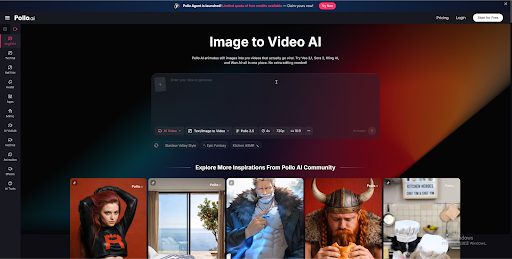
Pollo AI image to video offers a similar feature that indie teams have found practical for rapid iteration. For directors working on tight schedules, these capabilities serve multiple purposes: storyboard frames can become animated previews for investor pitches, atmospheric B-roll can emerge from location photos when reshoots are not feasible, and entire scenes can be visualized before a single shooting day is committed.
The quality of AI-generated motion has reached a point where the output is genuinely useful in professional workflows — not as a novelty, but as a practical tool that saves time and money at critical stages of production.
Practical Applications Across the Filmmaking Process
Beyond image-to-motion conversion, AI tools are proving valuable at several stages of production.
Pre-production visualization. Directors can now build animated mood boards and scene previews that communicate a film’s tone to collaborators and investors far more effectively than static documents. What once required a concept artist or an animatic team can now be sketched out in an afternoon.
Visual effects augmentation. Small VFX shots that would normally demand dedicated artists can be prototyped — or even finalized — through AI generation, freeing the budget for sequences that genuinely require human craftsmanship. Google Veo and OpenAI’s Sora have demonstrated strong results in this space, particularly for ambient environmental effects and camera motion simulation.
Marketing and audience development. Perhaps the most immediate return on investment comes from promotional content. A well-crafted trailer can determine whether a film finds its audience or disappears into obscurity, and that pressure falls especially hard on independents without studio marketing arms.
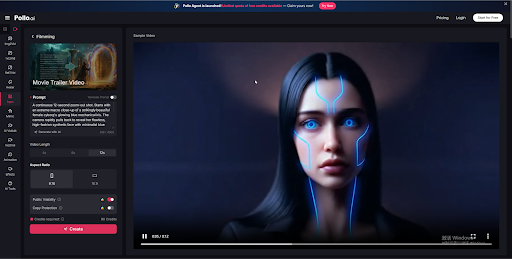
Platforms like Pollo AI include a dedicated movie trailer maker designed to help creators assemble professional-quality trailers with cinematic pacing and visual impact — even without access to a full editing suite or post-production house. Other tools across the ecosystem offer comparable features worth exploring based on a project’s specific style and format needs.
Festival and pitch materials. Submission packages that include dynamic visual content stand out. AI-generated sequences can elevate a pitch deck from a flat document into something that genuinely captures the energy and tone of a finished film.
What Filmmakers Should Consider Before Adopting AI Tools
As with any technology, not every AI platform suits every workflow. A few criteria are worth keeping in mind before committing to one.
Creative control. Prioritize tools that let you guide output through detailed prompts, style references, or uploaded source material rather than tools that default to fully automated results with little room for adjustment.
Output resolution and quality. Cinematic content demands higher standards than social media clips. Before integrating any platform into a real production pipeline, confirm that its output holds up on larger screens and under closer editorial scrutiny.
Integration flexibility. The best AI tools complement existing workflows rather than disrupting them. Consider how easily generated content imports into your preferred editing software — whether that’s DaVinci Resolve, Premiere Pro, or a leaner mobile-based setup.
Ethical transparency. Understand how a platform handles source material and intellectual property, particularly if AI-generated content will appear in commercially distributed work. This is an evolving area of both industry practice and legal consideration, and staying informed matters.
The Future of Independent Cinema: Creativity and Algorithms
AI is not replacing the independent filmmaker’s eye for story, character, or visual composition. What it is doing is dismantling some of the logistical and financial barriers that have historically limited small teams. The broader landscape — from Runway and Luma to Kling, Veo, Sora, and tools like Pollo AI — points toward a filmmaking environment where creative ambition, not budget, sets the ceiling. For directors willing to experiment, the possibilities have never been broader.